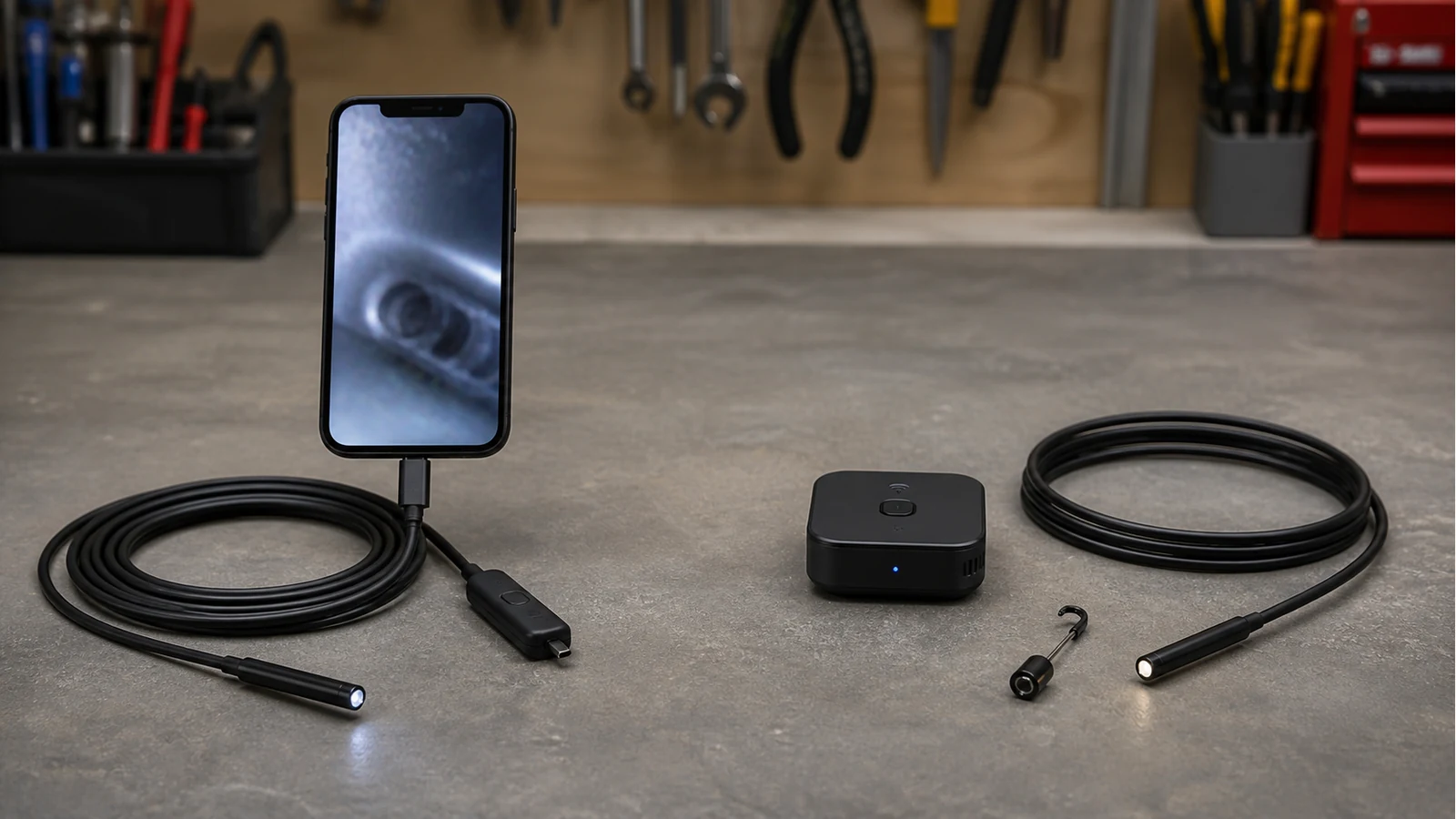
Usb-C Vs Wifi Endoscope Camera Uk
Direct answer: choose a wired USB-C/OTG endoscope when your phone reliably supports hosting the camera; choose Wi-Fi when adapters, ports or phone compatibility keep failing. Neither type is automatically best for every UK garage, plumbing or DIY job.
The decision table
| Factor | USB-C / OTG endoscope | Wi-Fi endoscope |
|---|---|---|
| Setup | Phone OTG support, adapter if needed, viewer app, permission prompt | Join camera Wi-Fi, open app, manage phone network behaviour |
| Stability | Good when the phone-host chain is proven | Can be affected by distance, interference or network switching |
| Power | Often draws from the phone or connected device | Often depends on a separate camera battery or module |
| Best fit | Close work such as engine bays, wall cavities and bench testing | Situations where the phone port is unreliable or physical connection is awkward |
| Common failure | Not detected, no permission, black screen | Connected to Wi-Fi but no image, dropouts, app mismatch |
Run the compatibility gate
Before ordering a wired camera, check the chain in plain English: phone supports OTG, adapter is a true data adapter, app can access a USB camera, and a first-image test works. The Android USB-OTG vs Wi-Fi compatibility guide frames that as OTG, adapter, app and first image, which is the right order for avoiding wasted time.
If the camera is detected but the screen stays black, do not immediately blame the probe. App permission, plug-in order and adapter quality are common weak points. The Android OTG/UVC setup and troubleshooting guide gives the same practical warning.
Where Wi-Fi is the sensible choice
Wi-Fi is not just the cheap or lazy option. It can be the practical answer when a phone port is damaged, an iPhone or Android adapter chain is awkward, or the user wants to avoid a stiff connector hanging from the handset. A mobile endoscope guide notes direct USB connections for reliability and Wi-Fi connections for broader phone convenience; see this mobile endoscope connection-method guide.
Where USB-C is the sensible choice
For close, methodical inspection, wired USB-C keeps the workflow simple once compatibility is proven. There is no Wi-Fi pairing step, no hotspot to join and fewer radio variables. That is why a wired setup often suits an engine bay, a domestic U-bend from arm's reach, or a workshop bench.
Who should not buy either phone style?
If you need PC-only industrial software, formal drain CCTV reporting, long multi-hour sewer surveys, or certified measurement, a basic phone endoscope is the wrong class. For domestic trap decisions, start with the U-bend inspection workflow; for deep drains, use dedicated drain CCTV equipment.
Conditional next step
If your phone has a confirmed USB-C/OTG path and your job needs a steerable close-range probe, the conditional wired USB-C articulating option is relevant. If your phone chain is uncertain, solve compatibility first or choose Wi-Fi.