Fixed tip vs articulating inspection camera: when is around £80 worthwhile?
We recommend spending around £80 on articulation when a recurring vehicle or plumbing inspection needs a view that an adequate fixed configuration cannot obtain. If a fixed view already answers the inspection question at a useful working distance, choose on the remaining requirements and total cost.
Is articulation worth around £80 for your jobs?
Spending around £80 on articulation is worthwhile when a recurring inspection needs a view that an adequate fixed-tip configuration cannot obtain. If a fixed tip can already reach and face the required surface at a useful working distance, we recommend choosing on the remaining requirements and total cost.
For occasional vehicle and accessible plumbing work, start with three questions: what surface must you see, which opening can you use, and where must the lens point once inside? Then consider how often you expect to repeat that check. This is a proposed buying method, rather than a measured payback calculation.
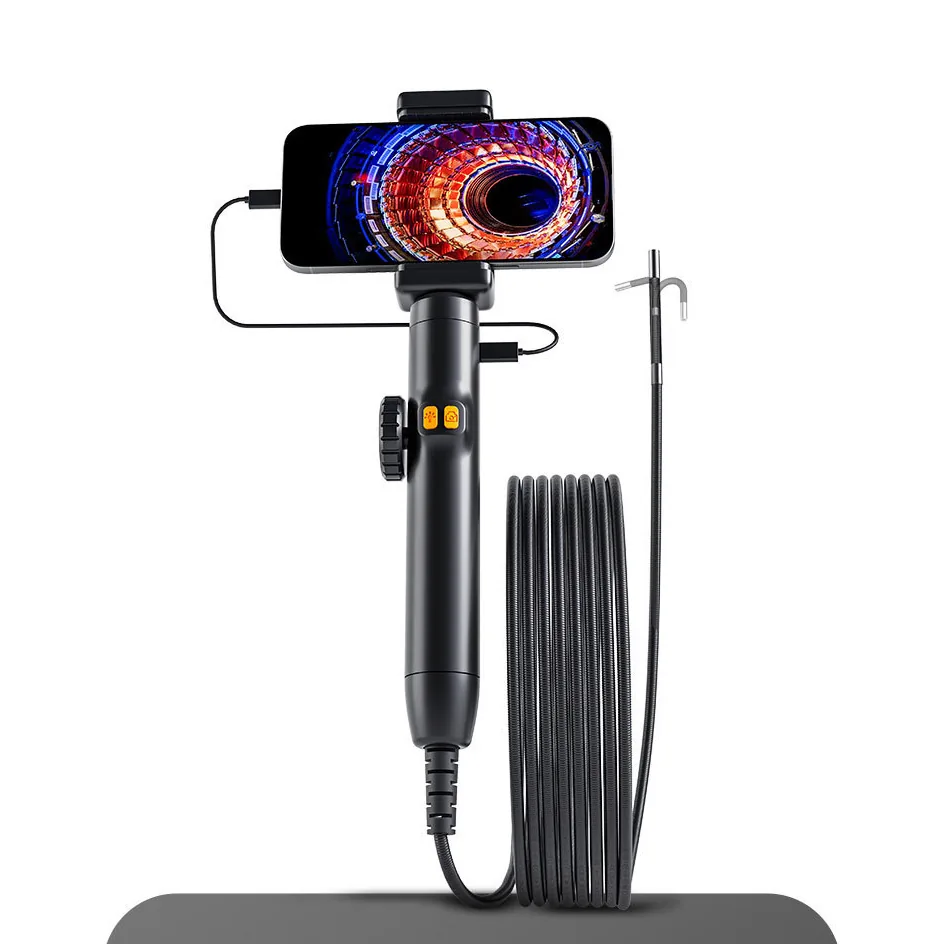
Endoscope Hub lists the WJD101 at £78.11 including VAT, with handset thumbwheel steering. That establishes an advertised steerable option within an approximately £80 equipment budget. It does not establish that steering will save you money or improve an inspection your existing viewing configuration already covers.
For example, consider steering if your intended vehicle check requires aiming towards a reachable surface after insertion. For a straightforward plumbing check, favour a fixed view if it already covers the target. Vehicle work alone is not a reason to buy articulation, and a straight pipe alone is not enough to establish that a particular fixed camera will show everything your task requires.
The comparison below separates advertised specifications from our conditional buying recommendations. It also identifies an important limitation: DEPSTECH documents front and side cameras for the NTC55, but the supplied product passages do not explicitly confirm whether its tip is non-articulating. It is therefore a dual-view candidate to investigate, rather than a verified fixed-tip benchmark.
Forward-facing, front-and-side-view or steerable?
Compare viewing direction and tip control separately. Use the following conceptual schematic to define the configurations you are asking suppliers about. It is not a product test, a coverage measurement or a representation of either shortlisted camera’s steering range.
VIEWING-DIRECTION SCHEMATIC — conceptual, not to scale

Fixed forward-facing configuration
Cable ─────[head] ───→ Forward view
                      No controlled tip steering

Fixed front-and-side-view configuration
                 ↑ Side view
Cable ─────[head] ───→ Forward view
                      Two viewing directions; no controlled tip steering

Steerable configuration
Cable ─────[aimable tip] ↗ View aimed using tip control
For a directly facing target, start by assessing whether a forward view would suffice. For a predictable sideways target, assess whether a documented side view would cover it. For a target that needs aiming after entry, assess a steerable option. These are proposed selection criteria; confirm the particular model’s capabilities and working distance before ordering.
The named products establish different things. DEPSTECH states that the NTC55 has front and side cameras, with perspectives switched through the app. Endoscope Hub states that a handset thumbwheel steers the WJD101 tip. The NTC55 passages establish two perspectives and app switching; they do not explicitly settle whether its head also has a steering mechanism. No named forward-only model is verified in the material available for this comparison.
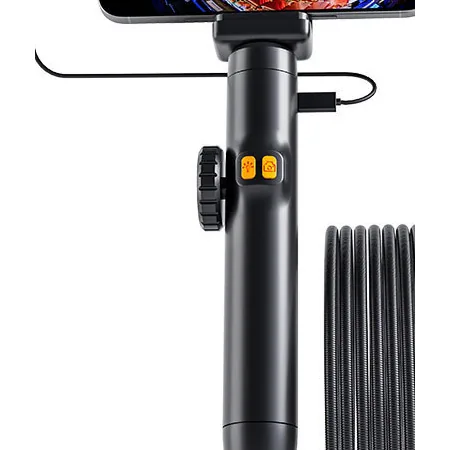
Keep cable flexibility and focus separate from that question. Both manufacturers describe their shortlisted cables as semi-rigid. Endoscope Hub separately describes the WJD101 cable as holding a bend and the thumbwheel as steering the tip. Ask for a documented steering control rather than inferring steering from a cable description.
Similarly, ask about focus and tip movement separately. The WJD101 listing gives a 2–10 cm focus range and a 70° viewing angle. It does not identify the focus mechanism as fixed, manual or automatic. Do not use the phrase “fixed focus” to decide whether a camera’s tip can steer.
When a fixed tip is enough
Favour a fixed tip when it can reach and face the surface required for your inspection at a useful working distance. Steering needs a specific purpose in your buying decision.
Endoscope Hub’s existing guide says: “Straight pipes, shallow ports and one-direction views rarely need articulation.” Apply that as conditional advice, using the required view rather than the entrance shape alone.
The following table is a proposed checklist for your jobs, not a set of tested applications for either shortlisted product.
| Your job | When to favour a fixed view | What to confirm |
|---|---|---|
| Accessible plumbing | The available position lets the camera face the particular fitting or surface you need to inspect. | Access, viewing direction, working distance and permitted wet use. |
| Straight pipe | The task needs a forward view that the proposed camera can obtain. | Whether the required answer concerns the view ahead, a patch of pipe wall, or both. |
| Shallow port | The target is directly visible from a position the camera can occupy. | Actual lens-to-target distance against the model’s documented working range. |
| Repeat inspection | The same access point and viewing direction cover the required surface each time. | The surface to record and whether the proposed configuration covers it. |
For a predictable sideways target, we recommend considering a confirmed fixed side-view configuration before paying specifically for steering. Choose it if the documented side view satisfies your task at the available distance.
DEPSTECH’s NTC55 provides a candidate to investigate: its listing describes front and side cameras with app switching. However, the supplied passages do not explicitly confirm a non-articulating head or specify working distances for those views. Obtain those details before treating it as the fixed-tip choice for your particular target.
An adequate fixed view deserves a fair place on the shortlist. Compare the remaining requirements and current total prices; do not assume every fixed-tip kit costs less, or that steering adds value merely because it is available.
When steering adds value for vehicle inspections
Shortlist steering for a recurring vehicle check when the opening points away from a reachable target and you need to aim after insertion. If a fixed configuration already provides the required view, vehicle use alone does not justify choosing articulation.
The WJD101 listing specifies thumbwheel tip steering, a 6 mm probe, a 2 m semi-rigid cable, a 2.9 cm lens head and a 2–10 cm focus range. Use those listed facts to frame a supplier enquiry about your access and target; they do not confirm suitability for an individual vehicle opening.
Consider these hypothetical buying examples. They illustrate the decision method, not tested vehicle applications or instructions for opening components.
| Hypothetical recurring check | Reason to investigate steering | Reason to favour an adequate fixed view |
|---|---|---|
| Recording the same side surface inside an accessible cavity | The available opening directs the lens past the target, and the proposed steerable kit can be confirmed to aim towards it. | A documented side view already covers the surface. |
| Revisiting a visible mark on an internal component | The required angle cannot be obtained with your proposed fixed configuration. | The mark is already visible at a useful distance without tip steering. |
| Viewing an end surface opposite a shallow port | You can identify an additional necessary view that requires aiming. | The forward view already answers the limited inspection question. |
Before buying, describe the access point, required surface, available aiming space and lens-to-target distance to the supplier. Let your expected frequency of use inform the decision. These listings do not establish a labour saving, payback period or durability advantage.
Keep the conclusion within the view obtained. We recommend recording which surfaces you could and could not inspect, rather than treating one photograph as a complete inspection. Endoscope Hub’s guide cautions that an endoscope does not measure compression or find every micro-crack. Steering should be assessed as a viewing capability, without treating it as a complete diagnosis.
Compare the actual shortlisted kits
Compare these as two documented viewing options, with the NTC55’s fixed-tip status still unconfirmed. The table records manufacturer-listed specifications, not measured image quality, reliability or inspection coverage. “Not specified” means not specified in the supplied product passages.
| Buying criterion | WJD101 6 mm Articulating Inspection Camera | DEPSTECH NTC55, selected 7.9 mm/5 m variant |
|---|---|---|
| Viewing control | Handset thumbwheel steers the tip. Steering range and planes are not specified. | Front and side cameras; perspectives switch through the app. Presence or absence of tip steering is not explicitly confirmed. |
| Probe and head | 6 mm probe; 2.9 cm lens head. | Variant labelled 7.9 mm dual lens; head length not specified. |
| Cable | 2 m, semi-rigid; described as holding a bend. | 5 m, semi-rigid. |
| Working distance and viewing angle | Listed focus range 2–10 cm; viewing angle 70°. | Not specified. |
| Lighting | Six adjustable probe LEDs. | LED count and adjustment controls not specified. |
| Phone requirements | USB lead and app; Android, iOS and HarmonyOS listed. Exact connectors, app name, supported versions and individual models not specified. | Type C connector and Lightning adapter; iOS 11.0+ and Android 9.0+ advertised. DEPSTECHCAM required; Android needs OTG support with OTG enabled. |
| Advertised price | £78.11 including VAT (£65.09 excluding VAT). | Selected variant $34.99 USD; page states tax included and shipping calculated at checkout. |
| Waterproof boundary | Probe listed as IP67; seller instructs users to keep the handset and phone plug dry. | Component-specific waterproof coverage not specified. |
The WJD101 price is an advertised listing amount, not a newly verified checkout quote. Check current price and terms before ordering. The NTC55’s US-dollar listing does not establish a comparable UK VAT-inclusive delivered price. No articulation premium or saving can be calculated from this comparison.
For the required view, assess the WJD101’s documented steering against the NTC55’s documented front-and-side perspectives. Confirm the NTC55’s steering configuration and working distances before deciding it is the fixed-view alternative you need. Confirm exact phone compatibility for either product; an operating-system list alone is insufficient grounds for promising that your particular connection will work.
The listings do not establish which option produces better usable images, lasts longer or saves more time. Make a conditional selection against your job requirements, and leave those comparative outcomes unknown.
Source listings: WJD101 specifications and price · DEPSTECH NTC55, selected variant.
Why steering does not guarantee passage around drain bends
Do not choose articulation solely in the hope of passing drain bends. Assess reaching the target separately from aiming the lens when it gets there.
Endoscope Hub describes the WJD101 thumbwheel as steering the tip. Its operating guidance separately says: “Push the 6 mm probe in only as far as the cable moves freely.” That is a conditional limit on advancement, not a promise of passage through an elbow.
The WJD101 product page lists a 6 mm probe, a 2.9 cm lens head and a 2 m semi-rigid cable. Those dimensions do not establish clearance, usable reach or withdrawal through your particular route. The supplied listing gives no minimum bend radius or clearance tolerance.
For a bent pipe route, we recommend asking the supplier about three separate requirements:
- Entry: give the measured opening dimensions and ask about clearance for the complete head and any fitted attachment. Do not assume a nominal 6 mm opening accepts a nominal 6 mm probe.
- Passage and withdrawal: describe the bends, restrictions and distance to the target. Request confirmation relevant to that route rather than treating cable length as guaranteed usable reach.
- The final view: identify the surface to inspect and the space available to position and aim the head.
Favour steering when access is adequately confirmed and aiming would add a required view. If passage around a bend is still unresolved, seek route-specific confirmation before choosing either configuration.
When another diagnostic tool is needed
Choose another diagnostic capability when the required answer exceeds a supported visual inspection. Paying for tip steering should follow that decision.
Endoscope Hub’s existing guide states: “An endoscope does not measure compression, find every micro-crack, or replace a proper sewer reel.” We recommend applying that buying boundary as follows:
- Compression: choose compression-testing equipment when you need a compression measurement. Assess a camera separately for any visual inspection you also require.
- Suspected micro-cracks: do not rely on an apparently clear image to rule out every crack. Seek a suitable defect-verification method; this comparison does not establish which method your component requires.
- Long sewer runs: consider a purpose-built sewer inspection system when the route exceeds the shortlisted kit’s documented capabilities. Ask for confirmation against the actual run, access and required coverage.
- Specialist visual inspection: consider a professional borescope when a required view, recording capability or defect-assessment capability is missing from your current kit. Request evidence for that specific capability before upgrading.
The WJD101 listing specifies a 2 m semi-rigid cable and a 2–10 cm focus range. Use these as listed constraints when assessing the job, without treating them as demonstrated coverage of a particular route or component.
A phone display alone should not decide whether equipment suits professional work. Our recommendation is to choose against the required access, view and inspection result. This comparison provides a buying boundary; it does not specify compression-test procedures, crack-verification techniques or a complete sewer-system shortlist.
Choose for the view you need
Choose for the view your recurring job needs. Favour an adequate fixed view, consider steering for a required view that needs aiming, and choose another diagnostic capability when the task exceeds the kit’s documented limits.
Before ordering, use this checklist:
- Clearance and route: confirm the complete head dimensions, attachments, passage, aiming space and withdrawal route. Nominal probe diameter is not clearance approval.
- Working distance: compare the intended lens-to-target distance with the chosen model’s documented range. Endoscope Hub lists a 2–10 cm focus range and 70° viewing angle for the WJD101. Obtain corresponding details for any alternative you are assessing for the same target.
- Exact phone requirements: ask for confirmation of your phone model, system version, connector, supplied lead or adapter and required app. The WJD101 listing names Android, iOS and HarmonyOS and describes a USB lead and app; it does not identify the app, exact connectors or supported versions. Do not assume universal compatibility.
- Wet components: the WJD101 listing identifies the probe as IP67 and says to keep the handset and phone plug dry. Keep your phone dry too. Obtain written confirmation for any other cable sections, joints or wet-use conditions your job involves.
- Price and terms: check the current checkout total and applicable returns and warranty terms. Do not infer trade-use coverage, repairability or replacement times from a warranty badge.
- Delivery: if an inspection date depends on arrival, clarify the seller’s timing before booking. The product page contains both “dispatches Monday morning” and “Free UK next-day delivery over £50”. Read the shipping policy and obtain an expectation for your address; those product-page phrases leave dispatch and arrival timing unresolved.
For an adequate fixed view, choose on the remaining job requirements and total cost. For a useful steerable view, review the WJD101 specifications and current terms against your access and target. For a predictable front-and-side view, investigate the DEPSTECH NTC55, while confirming its steering configuration and working distances before treating it as the fixed-tip alternative.
If the required answer is compression, verified defect absence or coverage beyond a short kit’s supported capabilities, direct the budget towards the appropriate diagnostic equipment instead of choosing on steering alone.
The product page is the source for the WJD101 specification, price and availability. On 16 November 2026 it shows £78.11. Check the price again before you order. View the WJD101 6 mm articulating inspection camera — £78.11
References
- Articulating vs Fixed Endoscope UK: Is Steer Worth £78? | EndoscopeHub
- WJD101 6 mm Articulating Inspection Camera
- WJD101 6 mm Articulating Inspection Camera
- DEPSTECH NTC55 2K Dual Lens 2560P Phone Borescope Endoscope Camera wit
Related guides
- 6mm borescope probe clearance: check access and the view beyond
- WJD101 wet inspections: the probe is listed as IP67; keep the handset, phone and connector dry
- Articulation for reachable HVAC side-wall views: check access and coverage
- For occasional jobs around £80, I’d choose steering only for a recurring view that needs it